DA Kentner is an award winning author who also enjoys meeting and interviewing authors of many genres.

As author KevaD, my novel "Whistle Pass" won the 2013 EPIC eBook Award for suspense. Previously, in 2012, it won a Rainbow Award in the historical category. "Whistle Pass" is currently out of print, though I'm considering finding a new publisher, or self-publishing the novel. What do you think?

"The Caretaker", a 3,000 word short story, won 'Calliope' magazine's 18th annual short story competition. Click the blue ribbon to view their site and entry rules for this year's short fiction competition.

Friday, November 1, 2013

Historical Mystery Author B.B. Oak


B.B. Oak is the pseudonym for the writing duo Ben and Beth Oak. Connecticut natives, they met at Boston University and have been together ever since. Besides the enjoyment they find in each other, the pair of writers has an affinity for Henry David Thoreau. It is this kinship and respect, as well as a love of mystery that inspired the Oaks to create a unique, though very real, role for the iconic Walden Pond resident. 

In Beth and Ben’s debut novel “Thoreau at Devil’s Perch,” Thoreau adopts a Sherlock Holmes style of investigating as the storied author and poet seeks to identify the killer of a young black man he found at the bottom of a rocky crag called Devil’s Perch. Told through the voices of Thoreau’s partners in this investigation, displaced lovers Julia Bell and Dr. Adam Walker, the Oaks draw upon Thoreau’s own documented words, passions, and survival skills to create a scenario so believable, many will agree that Thoreau could have rivaled the greatest detectives of the time had he chosen that pursuit. 

The Oaks go to great detail to remain true to the era, and the end results are carefully crafted settings such as the woodlands, town streets and businesses, and even a den of ill-repute. Historical fans will find little to raise a brow at. Thoreau fans will discover a character much like the man himself who speaks in his time-tested manner that has kept readers enthralled for centuries. Mystery fans will have their powers of observation tested against that of Thoreau, the American version of Holmes. And, of course, if Thoreau is Holmes, then star-crossed lovers and narrators Adam and Julia are Watson. 

“Thoreau at Devil’s Perch” has something for everyone. Most of all, it contains a very enjoyable, well-written story utilizing uncommon characters that will create fans for books to come. And, yes, the next tale in the series is on the horizon.

Q) Placing Thoreau in any role other than “expected” could have been a literary death knell.  But, you pull it off.  What gave you the self-confidence to turn Thoreau into a man determined to solve a murder others scoff at? 

A) Ben – Thoreau's own self-confidence inspired us.  He never gave a hang about what others expected of him.  It was Thoreau, after all, who coined the phrase about marching to the sound of your own drummer.  Like all great gumshoes, he was a loner with his own sense of honor and justice. 

Beth – And he was a master of observation and deduction, as his journals demonstrate.  So we simply portrayed him as he was in life, a natural born detective devoted to seeking out the truth and fighting injustices.  

Q) Had the two of you not met, what writing paths would you each have embarked on, and, will those paths make appearances in your future works? 

A) Beth – Never to have met Ben?  Impossible to contemplate!  Even at eighteen we both knew that we wanted to be writers and would most likely stay together. 

Ben – What we didn't know is that we'd be writing together.  Our career paths have gone in different directions until now, so we bring separate skills and   interests to our writing partnership. 

Beth - Ben is a lot better at writing actions scenes and nature descriptions than I am.

Ben – Beth is better at dialogue and character motivation.  As far as plotting goes, we talk it out together, bouncing ideas off each other.

Beth – And trying to top each other to make the action scenes more exciting and the plot more complicated.  Turns out Ben is quite bloodthirsty.

Ben – And Beth is quite devious. 

Q) Julia and Adam are risky characters – cousins in love.  Why create an atmosphere of forbidden romance for them in a story already rife with intrigue? 

A) Ben - We wanted the mystery to unfold from both a male and female perspective because men and women lived in separate spheres at that time.  And to make it all the more interesting, we decided to have the two characters telling the story develop a strong sexual attraction for each other as the mystery unfolds.

Beth – It's not just a sexual attraction.  Julia and Adam have loved each other since they were children.  Their love might even go back centuries.  They could well be soul mates that have lived past lives together.  This ties in with Thoreau's open-mindedness to the possibility of reincarnation.

Ben – In any case, if you're going to have romance in a mystery, it should be rife with conflict and obstacles.

Beth -   And isn't what is forbidden all the more desirable? 

Q) Even Sherlock Holmes grew and changed as a character.  Will readers see Thoreau grow as well
in future books, and if so, what areas do you see as potential areas for change? 

A) Beth – Thoreau is only twenty-nine when the first book opens, filled with expectations and wide open to change.   

Ben – As in real life, he'll become less a loner when he leaves Walden Pond.  He'll form very close relationships with others. 

Beth - Especially with Mrs. Emerson.  In our second book, Thoreau is living with Lidian while Ralph Waldo travels in Europe. 

Ben – Thoreau has a lot of trials and disappointments ahead of him, but he'll always remain purposeful and principled.  We intend to stay true to the basic elements of the real Thoreau's character, which we find inspiring.   

Beth - And we hope to show him as he really was, a vital young man full of joy and warmth and love. 

Q) Any parting comments for readers? 

A) Ben – Well, being big fans of historical mysteries ourselves, it's tempting to tell them that "Thoreau at Devil's Perch" delivers what readers of the genre want.  But maybe that sounds presumptuous.

Beth - You're right, it does.  How can we presume to know what other readers want?

Ben - Then I'll speak for myself.  The sort of historical mysteries I want to read are well-researched, have fascinating characters that reflect the era, and are filled with rousing action and unexpected plot twists.  Weren't those the criteria we used when we wrote our book?

Beth – Yes, but it's up to the readers, not us, to declare if we met them.  My only parting comment for them is that I hope they enjoy reading "Thoreau at Devil's Perch" as much as we enjoyed writing it.

Ben – Ditto.

Beth – And we also appreciate having this opportunity to answer such interesting questions.  They really made us stop and think about our book and why we wrote it.
DA Kentner is an award-winning author www.kevad.net

Saturday, October 19, 2013

Historical Fiction Mystery Author Anna Loan-Wilsey


Iowa’s Anna Loan-Wilsey goes to great lengths to research the historical locations her amateur sleuth Hattie Davish finds dead bodies in. Which is a good thing since Anna’s latest novel “Anything But Civil” takes place in 1892 Galena, IL, a community just ‘up the road’ from where I live – a town I’ve visited many times, located near the junction of two rivers I’ve pulled more fish from than I could ever lie about. Needless to say, but I will anyway, I was elated to find almost nothing to nitpick. Kudos to the author for her devotion in establishing proper settings, atmosphere, and ambiance. 

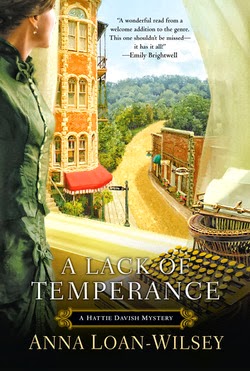
“Anything But Civil” is the second book in the Hattie Davish cozy mystery series. The debut offering, “A Lack of Temperance,” introduced readers to sleuth Hattie, a traveling secretary with an eye for detail, an ear for eavesdropping, and a nose in pretty much everybody’s business. Hattie is a delight, and, as she is young, attractive, and unmarried, there is no lack of potential suitors, leaving the reader wondering when, or if, the right man will capture Hattie’s heart. 

Anna Loan-Wilsey began her journey to become a published author after she lost her job. She scoured the Internet for tips, attended classes, conversed with authors, all the while honing her craft. Her efforts were rewarded with a contract for “A Lack of Temperance.” She then learned about deadlines, and just how much of a business being a published author truly is. Still, she makes time to hang out at the local Barnes and Noble play place with her daughter and answer any and all questions folks might have for her. In other words, she’s a nice lady, a mother and homemaker who is living her dream. 

I appreciated the fact Anna takes great care in creating not just her primary characters, but the secondary ones as well. If a character is involved in a scene, the reader is left with no question of who he/she is and their appearance and importance to the story. Overall, Anna’s writing is clean, precise, humorous when it deserves to be, and makes us wonder ‘who-done-it.’ 

Readers who enjoy cozy mysteries set in legitimate historical settings should definitely pick up one of Anna’s books.

Q) The obvious question: Why historical settings?
 

A) Would it be an obvious answer if I said because I love history? I live in a Victorian farmhouse, complete with a parlor, a library, and Bradbury & Bradbury wallpaper.  I wore a bustle dress for Halloween in high school when my friends were dressing like Madonna.  I collect 19th and early 20th century china teacups which I drink tea from every afternoon.  When given the choice, i.e. not a book club selection, I always prefer to read historical fiction.  I could go on and on.   So given the choice of writing in the present or being given the opportunity to research minute tidbits of an era and then pulling them all together to create a story from the past, there was no contest.  As I work I become completely immersed and “live” in that time period. It’s about as close to a time machine as I can get.

Q) Since you opt to use differing, genuine locations instead of fictional ones, what is the deciding factor in selecting the community? 

A) I like to think of my setting as a vital character in each book, drawing my plots directly from the history of the town. Therefore I’m always on the lookout for communities that have intriguing stories of their own to tell.  Eureka Springs, AR was famous for its healing mineral springs. Galena, IL was at one time a thriving steamboat town with a rich Civil War legacy.  Newport, RI (the setting of book 3) is infamous as a playground for the richest of the rich in America.  As many towns fit this criterion, I then narrow it down to those that have preserved their historical architecture as well. I want my readers to be able to walk through a town and sense that, besides the clothes and the cars, what they’re seeing is what Hattie would’ve seen.  

Q) You’re a biologist and librarian. Will those experiences play roles in Hattie’s development in future stories? 

A) Absolutely.  In fact, they already have.  Hattie is an amateur botanist which has served her well in solving several mysteries.  Hattie’s eye for order among chaos, her list making and her need to collect and catalog her plant collection were definitely inspired by my library background. 

Q) The romance door can only be opened and closed so many times in a mystery series before it becomes a yolk and/or tight wire for the character. How will you handle suitors and keep Hattie fresh without her becoming shrewish in her travels? 

A) Good question! I wish I’d considered it more thoughtfully before I wrote my first book.  As it is, Hattie has had a “steady” suitor almost from the very beginning, Dr. Walter Grice.  But without giving too much away, Hattie and Walter are like any other couple who must navigate the ups and downs that come with a growing attachment, including the physical distance between them, their differing social standings and of course, Hattie’s aversion to Walter’s profession.  

Q) Have you begun to create another character for a different mystery series, or does Hattie have your full attention, and why? 

A) Right now Hattie has my full attention.  I really like Hattie and I’m eager to see where she goes next. And besides, as it takes an enormous amount of time to research a new location for each book as well as the historical details that make the story authentic, it’s nice to have a familiar character I can rely on to step into a story with ease.  

Q) Any parting thoughts for fans and potential readers? 

A) Just to say thank you!  As it said in the introduction, I’m living the dream.  I know there are a multitude of new mysteries, let alone books, coming out every year.  To be able to add my effort to the list and actually have readers take time out of their busy lives to discover Hattie is a joy and a wonder.  I hope you enjoy stepping back into her world as much as I enjoy writing about it. 

DA Kentner is an award-winning author www.kevad.net


Friday, October 11, 2013

Spiritual Author Marion Stroud


During my mother’s last days, I sat at her bedside, and each day I read to her from prayer books in the hope she would find a comfort I couldn’t provide. I don’t pretend to understand the power of prayer, but I can attest to its presence and the peace it gave my mother, a former cancer survivor who ultimately surrendered to a stroke. 

When I learned Marion Stroud not only writes books containing prayers and Bible passages reflecting the joy and pain of being a woman, but also authored “Face to Face with Cancer: Comfort and Practical Advice for Sufferers and Carers,” a book prompted by the death of her father to pancreatic cancer, I knew I had to interview this special lady, especially when she’d gone to the trouble of contacting me. 

Bedford, England’s Marion Stroud started out as a physiotherapist. The birth of her children sent her on a path writing children’s books. Realizing a need for books written about finding faith after marriage, she authored “I Love God and My Husband.” “Loving God but Still Loving You” followed. 

Marion’s ‘Gift Series,’ prayer books surrounding friends, marriage, mothers, grandmothers, children, and maturing with grace, struck a chord with readers around the world, resulting in sales nearing a million copies and translations in fourteen languages. “It’s Just You and Me Lord,” a book offering prayers to women no matter where they are in life, was a Sam’s Club selection. With those kinds of statistics it’s hard to dispute Marion’s ability to connect with her audience. 

Her two dozen releases include “Dear God, It's Me and It's Urgent: Prayers for Every Season of a Woman's Life.” I want to note here that “Dear God It’s Me and It’s Urgent” is an Easy Print book. That means the lettering is large enough even folks with eyesight like mine won’t have any trouble reading this marvelous book of prayers and inspiration. 

Whether readers are in need of support, a shot of faith, or just want to enjoy prayers and passages designed for women everywhere, I heartily recommend picking up a book or three by Marion Stroud.

Q) I’m curious; why didn’t you return to physiotherapy?
 

A) I loved the opportunity to work with people, and help them to re-establish their physical fitness that being a physiotherapist gave me, but two problems faced me when our first baby was born. 

The first was that I had injured my back while helping a patient to walk during my pregnancy. Keeping an elderly lady on her feet when she slipped wasn’t good for my spine! 

The second problem was that in those days there was no ‘part-time’ work available; you either worked full time or not at all. I had always wanted to write, so if what I wrote could help people towards spiritual health, that seemed a great opportunity. 

Q) “Face to Face with Cancer” had to be difficult to write. Obviously the book has helped many family members, friends and strangers. But, what did writing the book do for you personally? What comfort or release did you find in the book? 

A) It was certainly the hardest book I’ve ever had to write. When my father was ill, I had five children at home and two of them were facing important examinations. I wanted to support them, as well as helping my mother to nurse my dad, and as a result I just blanked out my own emotions and got on with what I had to do. So when I wrote Face to Face with Cancer I was working through my own grief.  

Then 17 years later my publisher asked me to update it, just as my husband was diagnosed with prostate cancer. I cried all the way through the revisions, but the words of hope and comfort I offered to my readers helped me too. 

Q) You have been working on a fiction novel with the working title “Rumor of Angels” for some time now. How is that project progressing? 

A) Slowly! You know what they say about a ‘bird in the hand being worth two in a bush’, and when I get offered commissions, it’s easier to do what I know. But I have promised myself that before I write any more non-fiction, I will at least complete ‘Rumours’ and we’ll see where we go from there. 

Q) You’re still finding your way around social media sites such as Facebook, building a U.S. fan base. How do American fans differ from U.K. readers? 

A) The UK is definitely a post-Christian society. In a recent poll, around 78-83% of Britons professed a belief in God. However only a portion of these are practising Christians, who attend worship regularly,  and we have a much smaller Christian publishing industry than you do in the US. Inspirational fiction for instance barely exists. However people still have a spiritual concern, and if you can meet them at the crisis points of life, and provide guidance in a time of need, they’re like any other fans and will look out for your next book. 

Q) Finding a foothold in any writing market is tough, and getting tougher. Your prayer books truly connect with readers. What do you believe your books offer that other prayer books don’t? 

A) One word – reality! I get as confused about how prayer works as the next person and often feel I don’t know enough or pray enough. But one thing I do know is that I can talk to God about anything, and be wholly honest about my doubts and my fears. He listens, he loves me and there is no area of life that is beyond his care. 

Q) Any parting comments for fans and readers new to your work? 

A) I am passionate about the power of the written word to comfort, inspire and inform people and consider myself very blessed to have been able to be a writer. I love the words of the author of the classic ‘Imitation of Christ’, Thomas a Kempis when he wrote: "If he shall not lose his reward, who gives a cup of cold water to his thirsty neighbour, what will not be the reward of those who, by putting good books into the hands of those neighbours, open to them the fountains of eternal life?”
DA Kentner is an award-winning author www.kevad.net


Wednesday, October 9, 2013

Author Alison ‘Ellie’ Heller


Alison ‘Ellie’ Heller is the acquisitions editor for an e-publisher, dedicated blogger, and single mom who also writes paranormal and fantasy romance novels. 

Her latest book, “A Matter of Fate,” follows the plight of half-trained Warder, Mona Lisa Kubrek, as she tries to identify the source of the death spells targeting humans. Along the way, Mona reluctantly accepts the help of Cart Dupree, a half-elf as interested in Mona’s unique magic abilities as he seems to be in checking out her bedroom talent. Unfortunately, Cart possesses the skills to locate Mona’s enemy, which means she has no choice but to dodge Cart’s advances, and an evil magician’s sorcery, while she battles her way to either heroine or victim. 

Ellie’s writing is sure to keep readers turning the page. She is skilled and provides her audience with artistic settings and carefully crafted, engaging characters. 

That all said, Ellie also believes in lending a hand. When she heard about a project designed to raise money for breast cancer education and funding mammograms for those in need, she was quick to respond. Her short story “Flock That” is included in “Shades of Pink: A Romance Anthology.” “Shades of Pink” includes works by thirty-three authors and available as gift with a donation during October. “Flock That” is Ellie’s story of a woman who has unresolved issues with an 'ex'. She's contemplating how to approach him when a friend helpfully fills her yard with pink flamingoes, immediately bringing her to the attention of the homeowner's board he chairs. Hopefully, he won't walk away…again. 

Ellie is a relatively new author still building a fan base and more than willing to share her journey on her blog where she writes about everything, including helpful advice on writing, becoming published, and whatever else is on her mind. Check her out. I think you’ll be glad you did.

Q) Before becoming a published, you worked with other authors, critiquing their manuscripts and offering writing advice. What finally convinced you to write your own stories? 

A) I've always been a writer, the nudge I needed was to start submitting my stories! Being in a great critique group helped a lot with my confidence letting me know I was ready to take the plunge. 

Q) The obvious question: Why focus on paranormal and fantasy when you write marvelous straight-forward contemporary romance too? 

A) I keep trying to write more straight forward contemporary but paranormal elements keep sneaking in!  Actually I'm about to take another tack and am focusing on a historical novel right now. We'll see how that plays out and if I can keep the shifters/elves/witches at bay. 

Q) Where can readers find “Shades of Pink”?
 

A) Shades of Pink is being offered as a gift to everyone who donates through http://www.stayclassy.org/fundraise?fcid=261380 to the National Breast Cancer Foundation. 

Q) How have your children adjusted to mom writing romance tales? 

A) My teen boys don't talk about it much, and my tween daughter wants to read my stuff, but it's still a little too 'hot' for her in my opinion, although the door does remained closed! (i.e. there's no explicit sex scenes.) In the end I think they're proud, they've seen and heard how difficult it is to be published, so they recognize it is an accomplishment. 

Q) You work for Curiosity Quills Press, a publisher focused on ‘out-of-the-box’ stories, hard-hitting dark sci-fi, speculative fiction, and paranormal works aimed at adults, young adults, and new adults. I’m aware you have a strong affinity for these types of stories, so, why are you writing romance? 

A) I like to feel upbeat and good after I read/write a story. Romances are, by definition, happy by the end, so it's a good fit. Plus I'm a romantic at heart. I like the idea that not only can you find someone who accepts you as you are, warts and all, but that each person has the capacity to grow and love someone, warts and all. 

Q) Any parting thoughts for fans and those not yet familiar with your work? 

A) Rather than talk about my work, it's a small list, I'd love to encourage people to donate to the “Shades of Pink” fundraiser for the National Breast Cancer Foundation. In case you need it, here's the link again to donate and receive your copy: http://www.stayclassy.org/fundraise?fcid=261380
DA Kentner is an award-winning author www.kevad.net

Thursday, October 3, 2013

Relationship Authors Trevor Crow and Maryann Karinch


There is no denying we live in an electronic age where relationships are sometimes mistakenly judged by the number of ‘friends’ we have on social media sites. The truth is that the wellbeing of our hearts and minds require the intimacy only personal, real-life connections can provide. 

Partnering with personal trainer and multi-published author Maryann Karinch, Trevor Crow and Maryann detail how to enhance and invigorate the precious commodity of human worth and contact in their book FORGING HEALTHY CONNECTIONS: HOW RELATIONSHIPS FIGHT ILLNESS, AGING and DEPRESSION. Inside this remarkable book readers will find true-life accounts of people whose lives have changed by embracing their emotional needs and letting love in. Trevor and Maryann explore the ‘how-to’ for building relationships, and the all-important maintaining those established connections. 

FORGING HEALTHY CONNECTIONS is about taking back control of what we each need to live healthy, productive lives. It is about the happiness and hope found within personal bonds, and providing the framework to achieve personal connections that will lead to a lifetime of fulfillment and satisfaction in who we are. 

Trevor Crow, LMFT, hosts "Keeping Connected," a weekly radio show about relationships, and is a licensed marriage and family therapist. Crow has a Masters in Marriage and Family Therapy from Fairfield University, Connecticut and also holds an MBA from Harvard University and a BS from Parsons the New School of Design. She practices and resides in Southport, Connecticut. www.TrevorCrow.com 

Maryann Karinch is the author of eighteen books, most of which focus on human behavior, and is the founder of The Rudy Agency, a literary agency specializing in non-fiction. She holds bachelors and masters degrees from The Catholic University of America in Washington, D.C. and is a certified personal trainer. She lives in Estes Park, Colorado.

Q) The book opens with “we are built for relationships.” What do you mean by that? 

A) Our bodies thrive when we have great relationships. They suffer when we don’t. The need for connection with other beings permeates the human body. Our bonds with other people profoundly affect our immune system—and we have a lot of science to back that up! In other words, relationships directly affect the mechanisms in our body that restore health and keep us healthy—and that make us sick.  Health and healing benefit from positive thinking, but thinking isn’t what sustains them—it’s feeling.  What gives our immune system juice is connecting intimately with another human being. The assumption that you are better off pursuing answers to all your problems intellectually is ruinous to relationships and to your health. 

Q) What are the top five themes that you explore in the book? 

A) Medicine is a left-brained discipline; healing is a right-brained process.

Healthy habits come from choices; physical well-being comes from feelings.

Stress is vital to self-defense; stress is lethal to health and healing.

Autonomy is vital for a human being; vulnerability is vital to connecting with another human being.

Cars are built so they can be fixed; people are built so they can regenerate. 

Q) Why are you critical of Cognitive-Behavioral Therapy, or CBT? 

A) “Deciding” and “thinking” alone don’t make people change. If you tell a cigarette smoker, “Stop smoking. Just make a decision and do it,” that will not work. People don’t make a big change unless they are emotionally invested in it. You can decide to stop smoking, but the thread running through the decision and the result is emotion. Try telling a toddler to stop screaming in the middle of a tantrum; it doesn’t work. A smoker is as emotionally invested in smoking as the toddler is in throwing the tantrum. Neither can cognitively turn off their behavior.

Now here’s the problem with people getting some kind of talk therapy, including Emotionally-Focused Therapy, which is what Trevor practices. There is a widespread acceptance in our culture—reinforced by lots of self-help books—that thinking through problems, deciding to change, positive thinking and so on, yield measurable results. As a result, therapy like CBT that is thought-based is reimbursable by insurance companies. Even though the patient’s change may be short term, the change occurred and is documented, making therapy like CBT “evidence-based.” But the reality is, change actually involves emotions. 

Q) You say that if one generation is stressed out, that can affect the health of the next generation—and even more than that. How does that work? 

A) This is the science of epigenetics. Basically, everyone has a certain genetic make-up, but just because we have a particular gene doesn’t mean it’s expressed. Angelina Jolie had a preventative double mastectomy because she has the BRCA1 gene and her doctors estimated that she had an 87 percent risk of breast cancer. That meant there was only a 13 percent chance the BRCA1 gene would not express itself.  

Various factors can cause genes to be activated or deactivated, so they either do or don’t express themselves.  We don’t have all answers on why yet, but we do know that our responses to environmental stimuli—like hunger or war that cause stress—can effect activation or deactivation. A pregnant woman’s response to stress can trigger that activation or deactivation, and that affects the fetus. If the fetus is female, she has the ability to pass along the change to her children, too, so the change becomes an inheritable trait.
DA Kentner is an award-winning author www.kevad.net
Tuesday, September 24, 2013

Literary Author Lorrie Thomson


When Lorrie Thomson began writing her debut novel “Equilibrium,” she never imagined how drastically her perspective would change before the story’s conclusion. 

“Equilibrium” is about a family coping with the aftermath of a husband/father’s struggle with bipolar disorder, and the ultimate tragedy brought on by suicide. It is the story of the impact mental illness can have on a family, both in life and death. Though poignant, “Equilibrium” avoids the trap of maudlin, telling the story through the eyes of a mother and daughter who have come to accept that life must be lived, only to see a new challenge surface that threatens their fragile stability. And it is that new challenge, the inherited bipolar trait in the son and brother, that rekindles all the fears and doubts and threatens to destroy what the family has rebuilt. 

Thomson devoted hour upon hour to researching her topic. But the full impact of what she was writing hit Lorrie’s heart when her son was diagnosed with schizophrenia. Though “Equilibrium” remained a fiction novel, the complex family dynamics became truth. 

“Equilibrium” is filled with drama. There is romance, love, dashed dreams, fear, and a boatload of emotion and conflict. But, always, there is hope. As stated, the story is told through the mother and daughter’s viewpoints. I liked that we could see how each handled the circumstances affecting their lives, and no matter how different they thought each other to be, in the end, their commonality far outweighed their perceived differences. 

Though technically a literary work, I would recommend “Equilibrium” to romance and young adult readers as well. There is definite attraction between major characters, and those relationships bring their own issues to an already struggling family. 

A former Bostonian, author Lorrie now resides in New Hampshire with her husband and children where she writes full time, hunts for collectibles, and chats with neighbors over a stone fence.

Q) How did your son’s diagnosis impact “Equilibrium”? 

A) I completed the first draft of “Equilibrium” before my son showed any symptoms of his disorder. After having experienced real-life trauma, and re-reading that draft, I was surprised by how accurately I’d portrayed the family’s reactions. In subsequent drafts, I’ve peppered in some from-real-life emotional responses. And the scene in which Laura and Troy visit the father’s/husband’s grave? That was written fairly recently, and helped me unravel a question I’ve been asking myself for years. How can you tell the difference between a loved one’s personality and his mental illness? 

Q) I find it interesting that a number of prerelease reviewers have recommended your book as a ‘must read’ for discussion groups and book clubs. You pounded the “I want to be published’ roads for ten years before finding a literary agent who believed in your work. So, how does it feel seeing those kinds of reviews for your debut novel? 

A) It feels wonderful! The response from the local high school has been overwhelming. I’m excited about the enthusiasm from both adult and high school book clubs. I can’t wait to sit down and discuss their reactions to the story. After hanging out alone with my characters, I’m looking forward to hearing the thoughts of many, many book clubs. 

Q) A follow-up question: What kind of pressure do those reviews put on you for your next book due out in 2014? 

A) Comparison is inevitable. That said, just like a parent with more than one child, I feel every novel I write is special in its own way. I hope the reviewers feel that way too!  

Q) Undoubtedly, some readers will be people who have suffered through the circumstances your
characters struggle with. What comfort do you believe your book can provide them? 

A) I believe there’s comfort in following the story of others who’ve weathered trauma, persevered, and ultimately thrived. There’s comfort in knowing we’re not alone. We all deserve real-life happy endings, even if those happy endings are different from what we imagined at the beginning of our journeys.  

Q) Your next book also deals with life after a loss. What is it about that subject that compels you to write? 

A) When searching for a story spark, I look to my own fears. And then, through my characters, figure out how to stand up to them. So many people have lost loved ones, and I admire their resilience. Even though “Equilibrium” and “What’s Left Behind” deal with loss, the story perspectives are very different. 

BTW, the 2015 book will deal with a different type of fear.   

Q) Any parting thoughts for potential readers? 

A) I hope readers come away from “Equilibrium” with the feeling of having connected with the Klein family, the warm fuzzy feeling of, yes, I’ve felt that too. I’ve been heard and validated.
DA Kentner is an award-winning author www.kevad.net


Tuesday, September 17, 2013

Historian and Fiction Author David O. Stewart


David O. Stewart is passionate about American history. His first three books were all nonfiction history books. “American Emperor” chronicles Aaron Burr’s attempts to undermine a fledgling United States and create his own empire. “Impeached: The Trial of Andrew Johnson and the Fight for Lincoln’s Legacy” takes readers behind the scenes into the dark world of politics and the real reasons for the battle for a presidency. “The Summer of 1787” follows the events, deals, and personalities that ultimately birthed our country’s Constitution. 

Stewart has now undertaken to explore a true mystery taken to the grave. On his deathbed, John Bingham, the lead prosecutor in the case against the Lincoln assassination conspirators, claimed Mary Surratt revealed to him a secret that could shake the republic. Bingham refused to disclose what the woman hanged for her role in a president’s murder told him. Master storyteller David Stewart elected to ‘discover’ for himself what that secret might have been, as well as the secret’s far reaching impact on a nation. 

“The Lincoln Deception” is Stewart’s fictional accounting of the information Bingham carried into death. In the story set in 1900, Stewart pairs a white small-town doctor with an African-American ex-baseball player, sending them on the adventure of their lives. Though the lead characters are fictional, the impeccable research utilized to tell this story is very real. “The Lincoln Deception” is a superb melding of fact, mystery, and imaginary ‘what-ifs’ that blow open the conspiracy shrouds surrounding the murder of a president and the unseen, dark forces behind the killing. 

Maryland resident David Stewart practiced law for over twenty-five years in Washington, D.C. His devotion to the constitution led him to argue cases before the United States Senate and Supreme Court. He is currently working on a nonfiction book about James Madison.

Q) You focused your law practice on criminal defense. Why? Surely, the victim’s rights are as
important to you as the accused’s. 

A) I wish I could report some deep thought on the subject, but it was a simple decision: I wanted to join the law firm in Washington that had the most interesting cases I saw anywhere – they defended lots of public officials, including Richard Nixon, and litigated many constitutional issues. So that choice put me on the defense side in criminal cases. I occasionally thought about trying the prosecution side, but I was enjoying my practice too much to switch. 

Q) “The Lincoln Deception” is about uncovering the truth behind Lincoln’s murder, about identifying all of the people and reasons. The accounting places the nation in the ultimate role of victim, and the lead characters find themselves in the roles of quasi-prosecutors/investigators tasked with bringing additional criminals into the light. So, how difficult was/is it for you to pursue the criminals instead of defending them under color of law? 

A) The emotional and intellectual choice was easy! First, I certainly wasn’t sympathetic to John Wilkes Booth and his fellow conspirators. Moreover, defense lawyers, particularly in the fraud and corruption cases I handled, spend a lot of time investigating exactly how something happened and why their client broke no law. Experience as a defense lawyer is very helpful for investigating a crime, like the Lincoln assassination, that happened 150 years ago. The defense has to be resourceful and creative, since it has far fewer tools for investigation: no policemen, no grand juries, no pretrial subpoena power. Not that different from doing historical investigation. 

Q) History will always be one of the greatest mysteries. No matter how much we believe we know, evidence constantly surfaces to question what we have held as truth. What was the primary thought or concern you wanted to leave with readers in “The Lincoln Deception”? 

A) The Booth Conspiracy was different. We have had four presidential assassinations. Three (Garfield, McKinley, Kennedy) involved lone assassins with a single target, the president. The Booth Conspiracy involved at least ten conspirators (probably more) who meant to kill at least four targets: Lincoln, Vice President Andrew Johnson, Secretary of State William Seward, and General Ulysses S. Grant. If they had succeeded, it would not have been a mere presidential assassination. It would have been a coup d’etat. 

Q) For you personally, what is the most intriguing aspect of Lincoln’s assassination? 

A) The episode that begins The Lincoln Deception: that 35 years after the assassination, the lead prosecutor, John Bingham, said he learned a secret from Mrs. Surratt that he never revealed because it could destroy the republic. When I told friends about that episode, they always demanded, “So, what was the secret?” But Bingham took the secret to his death. That’s pretty darned intriguing! I wrote the book to try to figure out that secret. 

Q) As this is your first fiction novel, will we see another? 

A) Absolutely: I’m under contract to write another one. In it, Dr. James Fraser and former ballplayer Speed Cook will wrestle another historical mystery. 

Q) Having scanned dozens of reader reviews for “American Emperor” it is clear that your book opened many minds to the turmoil and greed this country had to overcome before it became settled on its foundation. What impact do you believe your book on James Madison will have on readers? 

A) Madison is a terribly underappreciated figure. He was a key actor in so many essential events in the nation’s founding: the Constitutional Convention, the ratification of the Constitution, the creation of the first federal government, the Bill of Rights (which he wrote), the creation of political parties, and our first war as a nation, the War of 1812. It’s an amazing record of achievement, yet he always seems overshadowed. I hope to explain why this small, quiet, studious fellow had such an outsized impact on the founding of the world’s first constitutional democracy. 

Q) Any parting comments for fans and readers new to your work?
 

A) Aside from thanks? Stay curious, I guess. It’s a huge world out there, and books can take you to the most fascinating parts of it.
DA Kentner is an award-winning author www.kevad.net


Monday, September 9, 2013

The Greatest Untold Story


What is the greatest untold story? The answer is actually quite simple; it’s yours. 

We all want to know where we came from, who our ancestors were and how they lived. It’s the lack of information and innate drive to fill the gaps that has made heritage and genealogy businesses so successful. It’s why children magically sit still, their mouths agape in wonder, when those ‘secret’ family stories are told about the time grandma was a little girl and tackled the neighbor boy to deliver a May Day kiss, or how grandpa attached wheels to a stolen outhouse and rolled it down Main Street on a Sunday morning. Okay – it wasn’t my grandfather. That was Dad and his cousin John Kincaid. And, yes, Mom wasn’t about to let that cute boy get away with leaving candy on the doorstep and escape without a peck on the cheek. For those who don’t know, May Day used to be the track ‘n field version of Valentine’s Day without the cards. 

The point is that these stories need to be shared. Video legacies are delightful, but they don’t truly convey the passion, the raw emotion, contained within the written word. Videos don’t allow for the tactile mystique a flower discovered pressed between a book’s pages can provide, or the lingering waft of perfume from an unsent love letter. 

You don’t have to be bestselling author Robert Tanenbaum, Juliet Marillier, Marcus Sakey, or Marilyn Brant to write your story. Nor do you need to hire editor Ellen Datlow. You just need to write, even if it’s nothing more than a line or two recapping the week’s events. 

You may think you have nothing to say, that you’ve never done anything noteworthy, but I promise that you are far more intriguing than you think. What you believe is an uninteresting quirk, such as absolutely needing a cup of green tea to start your Saturday or the entire weekend is off kilter, will have some descendent saying in wide-eyed amazement, “So that’s where I get that from.” The time you huddled under a blanket on the couch while your spouse, armed with a badminton racquet, chased a bat, only to slap the winged creature under the covers with you, will have your great-grandchildren rolling on the floor in laughter. And, I guarantee that passing down the secret ingredient to the butter noodles your family insists be on the table every Thanksgiving will elevate you to immortal fame. 

Write your story. Share what your father did every morning before he went to work; your sibling’s most annoying habit, how you pursued a singer’s tour bus to get an autograph, or, how you were too shy to tell that first crush how you felt and still wonder now and then about what might have been. 

So, how to begin, and then ensure you don’t stop? I’ll turn that question over to literary author and writing instructor Patricia Ann McNair. Patricia’s missionary grandfather rode a motorcycle over a Korean mountain range just because no one had ever done it before. How sad it would be if that story hadn’t been passed down for his descendants to treasure. Patricia and her award-winning novel “The Temple of Air” can be found at http://patriciaannmcnair.com/ 

Hi, All. Here are Five Steps to Writing Your Story 


1.     Get comfortable. Find a place where you like to sit, choose a pen that makes a nice line, get a journal that opens easily, stays open, and gives you room to write. Make the experience a pleasing one, even if you sometimes find the writing itself a challenge.

2.     Make a list, write it quick. James Thurber said, “Don’t get it right, just get it written.” A list can help you do that. Fragments, slivers, a gathering of possibilities. Start with these: “What I Remember;” “What I Don’t Remember;” “What I’d Rather Not Remember;” and “I’ve Been Told.” Don’t think too hard, jot down anything that comes to mind: big events, small details, small events, big details. Look at these lists often, and see what can (or needs to be) written and told more fully.

3.     Write a letter. Even though I knew my grandfather’s story, it wasn’t until I found decades of his letters from that time that I really knew the details of his “climbing the crooked trails” (as he referred to his motorcycle missionary work.) In your journal, it can help to address the writing as a letter—to a friend, to a relative, to a stranger who needs to know this story. Or, if you prefer to write an actual letter and mail it to whomever, make sure to keep a copy for yourself. (And not just on your computer…hard copy.) Letters are an invaluable part of our personal histories and narratives.

4.     Make it a habit. Some say it takes 21 days to develop a habit. Set aside some time every day for 21 days to write in your journal. You might start writing a story one day, and then leaving off before the “good” part. The next day’s writing should come easier then; pick up where you left off.

5.     Read. Every writer needs to be a reader. 

I (Patricia) thought I would alert you to the Chicago Writers Conference. http://www.chicagowritersconference.org/ I'll be presenting there, and the woman who is its founder, Mare Swallow, is really sharp. Past participants from the inaugural conference last year have already had some successes, including a woman who got a three-book deal. Just thought it might be an interesting thing for readers to know about.
DA Kentner is an award-winning author www.kevad.net